Showing posts with label Dune. Show all posts
Showing posts with label Dune. Show all posts
Wednesday, September 29, 2010
Baron Harkonnen as Pedophile
One of the most disturbing characters in all the sci-fi genre is Baron Harkonnen, Paul Atreides's nemesis in Dune. Harkonnen is one of the first clear depictions of a pedophile in science fiction history, which alone makes him unusual. The character is quite well drawn, but nevertheless I find it disturbing how easily Herbert seems to conflate pedophilia with homosexuality, as the Baron's ambigous sexuality seems to stay rather on the homoerotic side. This is particularly noteable in the Dune miniseries, which unlike the Lord of the Rings movies, does not try to hide problematic elements of the original text (for which I give it credit). Yet you would think an intelligent sci-fi author could have gotten beyond that canard, even by as early a date as 1964. Just goes to show you that a genre that promotes human rights has not always done so consistently.

Wednesday, September 15, 2010
OCD and science fiction's responsibility to the mentally ill
Budd recently brought up Orson Scott Card's novel Xenocide, which created a religious movement out of OCD. As someone who suffers from OCD, I have always been fascinated by Card's depiction in Xenocide. I think OCD is a deeply underused mental illness in science fiction, even more than the almost equally underused schizophrenia and bipolar. Phillip K. Dick, at least, portrayed the complexity of schizophrenics lives in unusual, tender terms. But OCD is even a more interesting mental illness, in sci-fi terms. What Xenocide pointed out is that OCD has some evolutionary benefits. For instance, my OCD gives me literally almost superhuman powers of concentration. I can read 300, 400 pages a day often, or work on a paper for 10 hours straight, and not be tired. I think contemporary science fiction too often emphasizes the victimized or maladaptive elements of mental illness, without realizing that mental illness is not necessarily maladaptive, if channeled in the right directions. Of course it causes problems. But so does one's sexual orientation and science fiction authors don't routinely demonize LGBT people (nor should they).
I think science fiction really needs to come to terms with its own history of psychophobia. Obviously, I am in part talking about Scientology. I don't think its any accident that it was science fiction that created the most deeply anti-mentally ill ideology of the last century. Science fiction, from its conception, has always emphasized the power of the ubermensch, and therefore neglected the hidden powers that undermensch populations can also have. Science fiction's history of ableism and racism is directly linked to its inability to divorce itself from the myth of the superhuman. But I'd really like to science fiction to link itself to the underdog for a change, not for the Paul Atreides's, Enders, and Supermans of the world. Science fiction, quite simply, owes mentally ill people for the crimes done in science fiction's names. And it's about time that mentally ill people collect.
I think science fiction really needs to come to terms with its own history of psychophobia. Obviously, I am in part talking about Scientology. I don't think its any accident that it was science fiction that created the most deeply anti-mentally ill ideology of the last century. Science fiction, from its conception, has always emphasized the power of the ubermensch, and therefore neglected the hidden powers that undermensch populations can also have. Science fiction's history of ableism and racism is directly linked to its inability to divorce itself from the myth of the superhuman. But I'd really like to science fiction to link itself to the underdog for a change, not for the Paul Atreides's, Enders, and Supermans of the world. Science fiction, quite simply, owes mentally ill people for the crimes done in science fiction's names. And it's about time that mentally ill people collect.
Monday, August 9, 2010
Dune Miniseries: The Only Good Exploration of Fundamentalism in Sci-Fi
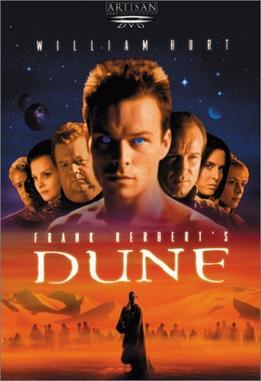
The Dune and Children of Dune miniseries are two of the best explorations of fundamentalism in television or visual sci-fi. Of course, this is partially due to the source material: Dune and Dune Messiah, in particular, were moving accounts of the growth of a fundamentalist culture and its tragic demise. What makes the Dune miniseries so exciting is that it refuses to play with easy stereotypes but instead shows the full complexity of fundamentalist belief. Even more importantly, these miniseries show the degrading effects of hero-worship on the worshipped, as a cultic group of priests quickly gains power in the Fremen-dominated fundamentalist hierarchy. The series also explores the link between ecology and religious belief, with the desert like conditions of Arrakis leading to a harsh, no nonsense religious belief. Dune's analysis of the deleterious effects of fundamentalist belief are sufficiently broad that they are unlikely to offend Muslims, Christians, or Jews, who are themselves fundamentalists. Instead, these series cause fundamentalists to ponder both the greatness and the pitfalls of their own religious traditions.
Subscribe to:
Posts (Atom)