I recently heard that Caprica, the BSG series targeted at female audiences, has been cancelled and is to be replaced with another Battlestar Galactica series, Blood and Chrome, about a "hotshot young pilot" Will Adama. Do we need any further evidence that the sci-fi channel is dumbing itself down even further than normal? How many times do we have to go through the "Top Gun" hotshot scenario before it gets old? It was entertaining in the BSG remake, but only because Starbuck was such a well conceived character. Clearly, this move is aimed at the testerone section of the public who wants more blood and battles.
This represents a continuing trend in sci-fi television to cancel shows that are either female friendly or portray complex female characters. I think that's one of the problems that Firefly (which I recently finished viewing) has had with the general audience. It made the mistake of viewing women as three dimensional human beings with complex personalities, personalities not reducible to stereotypes. Gina Torres's character (sorry, forgot the name), River, Caylee, and in particular, Inara, were superbly drawn, and therefore not appealing enough to men raised to simply view women as sex objects. This accomplishment was all the more remarkable considering that Inara's character was a Companion character, only the second starring sci-fi tv character to be a prostitute (Callie from the original BSG was the first). I think the real problem with the sci-fi genre as a whole right now is that it primarily read and watched by men, and is therefore targeted at the male, rather than female audience.
Showing posts with label Firefly. Show all posts
Showing posts with label Firefly. Show all posts
Sunday, December 26, 2010

Monday, August 16, 2010
The Moral Ambiguity Divide
 Science fiction television is divided into basically two halves: series that present basic battles between good and evil and tend to see the universe in terms of absolutes, and series which stress moral ambiguity. Here's how I'd divide the series:
Absolutist shows: Star Trek, TNG, Voyager, Enterprise, SG-1, Doctor Who (original), BSG (original), Buck Rogers, The Prisoner, Earth 2, V (original), Twilight Zone, Outer Limits
Ambiguity shows: Andromeda, Firefly, Farscape, Blake's 7, BSG (reboot), Torchwood, DS9, X Files
In the Middle: Babylon 5, Crusade, Doctor Who (reboot)
This is obviously not a full list of series. Which kind of series you like tends to depend a lot on your cultural and ideological background. As a rule, though I hold to some absolutist beliefs, I prefer the more ambiguous shows, because the writing is much better. Of my favorite series, only the original Doctor Who and The Prisoner are absolutist. Some of the other absolutist shows are fine, like The Twilight Zone and Outer Limits, but as a whole I just don't think these absolutist shows can match the nuanced characterizations of Farscape, Blake's 7 and Babylon 5. On the other hand, some shows have taken the ambiguity so far, such as Firefly and the BSG (reboot), that their characters are essentially cyphers and lack the depth of personality of a Kerr Avon or a G'kar. My other problem with the more ambiguous series, particularly with the new BSG (reboot), is that they sometimes sound too sympathetic to horrendous ideas, like the government eliminating certain civil rights during a time of war. I for one was more than a little pissed when Rosselin outlawed abortion for the good of the body politic in the new BSG, and I'm a pro-lifer! I thought Rosselin should stick to her guns and not give in to the "ends justify the means" rhetoric that has come to characterize the entire rebooted BSG franchise. I think JMS's position on Babylon 5, in which there are always choices, but always consequences to one's choices, is less likely to lead to this kind of relativistic anything-goes approach to civil rights and legal morality. But then again, I do like Blake's 7, which takes BSG's ambiguity and ramps it up ten degrees. I guess, though, that is because there is no sanctimonious pretense to moral strength on the part of Kerr Avon, which makes Blake's 7 more palatable than BSG, with BSG's constant desire to stay "relevant". Long term, I think Blake's 7 has been far more significant to the genre, because it refused to give some of the cheapened answers to moral questions that BSG delights in. Just my opinion though. Tell me what you think.
Category: Science fiction politico, science fiction politics
Saturday, July 17, 2010
Space Hookers: Prostitution and Pornography in the Final Fronteir
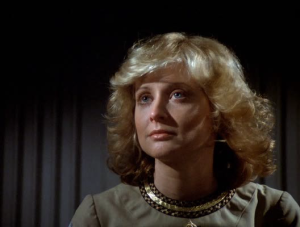
 Prostitution is one of those forbidden subjects in science fiction. No sixties show really got close to the issue, except perhaps for the trophy wives of "Mudd's women". Clearly, however, the Orionian slave girls in the series were meant as a rather unfortunately positive comment on sexual slavery. Even Gene Rodenberry admitted that that characterization was sexist. The first official space hooker that I know about, in tv sci-fi, was Cassiopiea in the original BSG, who was a socialator, a kind of high price Geisha. Cassi' space hooker origins were quickly dropped however, when the network felt that she was simply too controversial and sexual a character (Remembering Battlestar Galactica).
 Inara (pictured above), from Firefly, was the most impressive depiction of prostitution in science fiction television, being neither sexually exploitive, nor morally condemning, but just realistic about how prostitution would evolve in a future society. In Firefly society, Companions (the Firefly equivalent of prostitutes) have in some ways turned the tables on the pimps of previous eras, and serve as a kind of space age geisha or courtesan, with corresponding rank and privilege. Companions provide psychotherapy, choose their own clients, and are viewed as a form of nobility in Firefly society. Wheddon's ability to critique prostitution's many negatives, while still providing an interesting analysis of how the practice might change, is one of the truly innovative aspects of Firefly. Wheddon's series Dollhouse also imagines how prostitution might be used in the future. Both Dollhouse and Caprica warn of the potential problems of "futureporn", that is virtual pornography that condemns A.I. life to sexual servitude. I think this is an important issue that badly needs addressing, and not in the underused way that it was done in STNG episodes.. Unfortunately, modern sci-fi series seem reluctant, in general, to tackle the issue of sexual exploitation through pornography (I hail more from the anti-porn aspects of feminism, rather than the pro). Therefore, it seems of prime importance to me that future series deal with this issue, whether positvely or negatively. I think Dollhouse got close, but it's a major issue that science fiction television still has not adequately explored.
Friday, January 15, 2010
Top 100 Sci Fi Show List
Check this link for a top 100 sci fi shows. The top 25 are:
25. Terminator series
24. Prisoner
23. Cowboy Bebop
22. Space 1999
21. Hitchiker's Guide to the Galaxy
20. Farscape
19. V
18. Fringe
17. Stargate SG-1
16. Dollhouse
15. The Tick
14. Futurama
13. DS9
12. Twilight Zone
11. Blake's 7
10. Lost
9. BSG reboot
8. Babylon 5
7. X Files
6. Buffy
5. Max Headroom
4. TNG
3. Firefly
2. Doctor Who
1. Star Trek
My take on the top 25: Overall, this is one of the best of these lists I've seen, though none can be perfect. Firefly I think is rated a little high, though it certainly should be in the top 20, perhaps the top 10. Max Headroom I've not seen, but I'm not quite sure it's a top 10 show, at least in influence. I have no interest in Buffy or Lost, but I admit they may be good shows. It's good to see Blake's Seven and Babylon 5 high on the list. Twilight Zone should obviously be higher, as it is one of the most influential genre shows ever. Farscape too, is rated way too low, as is the Prisoner (the Prisoner should have a real shot at the top 5, both in terms of quality and genre influence). The only real problems I had with the picks was the inclusion of the Tick and Space 1999 in the top 25. The latter, in particular, is nowhere near as good as some of the other series on the list. Also problematic for me is Stargate's position, as I simply did not find it to be a quality show. I'd actually rate Andromeda and Enterprise above it. As for Star Trek and Doctor Who winning the top spots, here's my take. I certainly don't think they're the best series ever aired: Firefly, Babylon 5, BSG, Farscape, The Prisoner, and Max Headroom all had better writing. But in terms of genre influence, they are simply indispensable. I think in the future BSG and B5's influence will lead them to be rated higher in such polls (4th and 3rd respectively). However, I think Blake's Seven, arguably more influential than any series on the list save Star Trek, will never receive its due, because fans don't realize how much Firefly, Farscape, Andromeda, and Babylon 5 borrowed from it.
25. Terminator series
24. Prisoner
23. Cowboy Bebop
22. Space 1999
21. Hitchiker's Guide to the Galaxy
20. Farscape
19. V
18. Fringe
17. Stargate SG-1
16. Dollhouse
15. The Tick
14. Futurama
13. DS9
12. Twilight Zone
11. Blake's 7
10. Lost
9. BSG reboot
8. Babylon 5
7. X Files
6. Buffy
5. Max Headroom
4. TNG
3. Firefly
2. Doctor Who
1. Star Trek
My take on the top 25: Overall, this is one of the best of these lists I've seen, though none can be perfect. Firefly I think is rated a little high, though it certainly should be in the top 20, perhaps the top 10. Max Headroom I've not seen, but I'm not quite sure it's a top 10 show, at least in influence. I have no interest in Buffy or Lost, but I admit they may be good shows. It's good to see Blake's Seven and Babylon 5 high on the list. Twilight Zone should obviously be higher, as it is one of the most influential genre shows ever. Farscape too, is rated way too low, as is the Prisoner (the Prisoner should have a real shot at the top 5, both in terms of quality and genre influence). The only real problems I had with the picks was the inclusion of the Tick and Space 1999 in the top 25. The latter, in particular, is nowhere near as good as some of the other series on the list. Also problematic for me is Stargate's position, as I simply did not find it to be a quality show. I'd actually rate Andromeda and Enterprise above it. As for Star Trek and Doctor Who winning the top spots, here's my take. I certainly don't think they're the best series ever aired: Firefly, Babylon 5, BSG, Farscape, The Prisoner, and Max Headroom all had better writing. But in terms of genre influence, they are simply indispensable. I think in the future BSG and B5's influence will lead them to be rated higher in such polls (4th and 3rd respectively). However, I think Blake's Seven, arguably more influential than any series on the list save Star Trek, will never receive its due, because fans don't realize how much Firefly, Farscape, Andromeda, and Babylon 5 borrowed from it.
Subscribe to:
Posts (Atom)