Showing posts with label The Prisoner. Show all posts
Showing posts with label The Prisoner. Show all posts
Friday, January 14, 2011
What is your favorite Earthside sci-fi program?
Normally, I am more a fan of space opera than earthbound science fiction. My favorite space operas are Farscape, Babylon 5, Doctor Who, Blake's 7, and to a lesser extent, the new Battlestar Galacatica. But I was wondering what your guys favorite Earthbound series are. To me, the top two Earthbound series are The Prisoner and Max Headroom. I think the Prisoner set the surrealist tone for so much of the Earth-centered sci-fi that came after it, only it did it much better. Max Headroom, meanwhile, was the definitive cyberpunk show. Politically, Earthbound series tend to emphasize paranoia and distrust of the government, healthy attributes in a state-controlled era of media-spinned, entertainment-saturated American citizens. Many of the top earthbound series have leaned heavily left, particularly Max Headroom and The X-Files. My fear with earthbound sci-fi is not that it will supplant space operas (though it is doing that), but that it will no longer be creative. I just can't get that interested in what's going on in Lost's island or in the parallel universes of Fringe. Neither series, right now at least, appeals to me. I want some real sci-fi ideas, and some new ones, not recycled and inferior copies of great Prisoner and X-Files episodes. The age of remakes and quasi-sci fi should be over. A return to cyberpunk, to thoughful space opera, to outlandish science fiction ideas, should begin.

Wednesday, January 12, 2011
The Prisoner and the Arizona Shooting
I've been depressed while watching the news on Jared Loughner. As an advocate for the mentally ill, and as a mentally ill person myself, the demonization of the mentally ill occurring in the media is truly astounding. Every news station, from Fox to MSNBC, is using this issue as a political football, a chance to gain ratings. The pictures of Loughner are accompanied by scary music and orchestral accompaniment, the media completely oblivious to the fact that this may prevent a fair trial of this young man. People keep calling Jared's actions "heinous". I definitely think they are "tragic", but the term heinous implies that Jared knew what he was doing was wrong and no one has proven that as of yet.
No one is putting the blame on state health care programs that are cutting millions from mental health treatment in favor of more expensive prisons. Even supposedly responsible newspeople are using antiquated terms for Jared, like "madman", "psycho", etc. And of course, our beloved psychiatric community, as is typical, is, if anything, contributing to the media feeding frenzy. And people wonder why the mentally ill don't seek help.
If that wasn't bad enough, there are now calls to clamp down on free speech and hate speech, particularly the Tea Party movement. Readers of this blog will know I am no friend of the Tea Party, but I think these calls are asinine. And that brings me to Patrick Mcgoohan's The Prisoner. Mcgoohan, living in a pre-Cable age, was a fierce individualist, and also a fierce opponent of "individualism" as a political philosophy, rather than a personal outlook on life (in other words, he saw that individualism itself could be corrupted). The last episode of The Prisoner, "Fallout", truly exposed the moral bankruptcy of our media-created Villages, with their manufactured heroes and manufactured villains. Number 6 knew better, or at least I hope he would have. So, I for one, will not join the lynching party aimed at a (probably) schizophrenic young man. I'll leave that for our media intelligentsia. I'm sure they'll do a great job.
No one is putting the blame on state health care programs that are cutting millions from mental health treatment in favor of more expensive prisons. Even supposedly responsible newspeople are using antiquated terms for Jared, like "madman", "psycho", etc. And of course, our beloved psychiatric community, as is typical, is, if anything, contributing to the media feeding frenzy. And people wonder why the mentally ill don't seek help.
If that wasn't bad enough, there are now calls to clamp down on free speech and hate speech, particularly the Tea Party movement. Readers of this blog will know I am no friend of the Tea Party, but I think these calls are asinine. And that brings me to Patrick Mcgoohan's The Prisoner. Mcgoohan, living in a pre-Cable age, was a fierce individualist, and also a fierce opponent of "individualism" as a political philosophy, rather than a personal outlook on life (in other words, he saw that individualism itself could be corrupted). The last episode of The Prisoner, "Fallout", truly exposed the moral bankruptcy of our media-created Villages, with their manufactured heroes and manufactured villains. Number 6 knew better, or at least I hope he would have. So, I for one, will not join the lynching party aimed at a (probably) schizophrenic young man. I'll leave that for our media intelligentsia. I'm sure they'll do a great job.
Tuesday, August 24, 2010
O.B.I.T
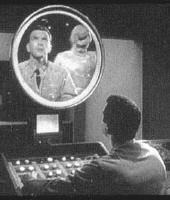
I just finished watching a fascinating episode from the Outer Limits, entitled "O.B.I.T." In many ways, it is a precursor to The Prisoner. The episode portrays aliens, with the unwitting cooperation of the U.S. government, installing monitoring computers around the country, preying on everyone's secret thoughts and exposing them to government censorship. Powerfully, one military leader admits that O.B.I.T. monitoring is like an "addiction", a "drug", that is self-feeding and self-renewing. In many ways, O.B.I.T. serves as a cautionary tale of the dangers of government computer surveillance technology. This was a persistent problem in the sixties, with the government using the most advanced surveillance technologies of the time to get rid of white socialist and black power groups, such as the Weather Underground and the Black Panthers. The episode also serves as a warning on the dangers of Mcarthyism, still a sensitive issue in early sixties America.
Saturday, July 17, 2010
Conservatism in Science Fiction Television
 Conservatism gets a bad wrap in science fiction (often deservedly so). However, science fiction television also tends to chicken out when dealing with conservative ideas. There seems to be a great willingness to critique social conservatism. DS9 condemns creationism, STNG anti-gay and anti-abortion activism, and BSG examines anti-terrorist rhetoric. However, I would argue that social conservatism, by and large, is a distraction and a dangerous distraction at that. Within a generation or two, virtually all Americans, including evangelicals and conservative Catholics, will be in support of gay rights. The abortion controversy may linger on longer, but clearly the religious
 right is ultimately going to lose that battle as well. By contrast, economic and governmental conservatism, particularly the former, are rarely critiqued in science fiction. We do have the Ferengi in TNG, the proto-capitalists of the universe, but if anything, they seem like a Fascist caricature of Jews (which some fans have suggested was exactly the racist point), rather than a serious, thoughtful analysis of economic conservatives, libertarians, and neo-cons. Babylon 5 probably did the best job of analyzing the dangers of conservative thought, with its depiction of President Clark's gradual decline from conservatism to fascism. Despite the prevalence of Tea Party thought in recent years, no series has really addressed the Tea Party issue either. Maybe it is just too new. I do think, however, that the critiques of science fiction television towards social conservatism are stupidly reductionistic, rarely examining the complexity of religious and cultural taboos. Again, Babylon 5 did a much better job, particularly "Confessions and Lamentations", a cutting, deeply moving exploration of the self-harm caused by homophobia and anti-AIDs rhetoric. Sci-fi television also seems reluctant to engage conservatives in dialogue or permit conservatives to have any voice in sci-fi television. Only two series, bnth British, have really engaged political conservatism. The first, the Prisoner, was an exceptional piece of libertarian production, widely considered to be the best sci-fi series (perhaps the best series) ever made. Patrick Mcgoohan,
 the show's creator, explored themes of individualism and social conformity in a way that appealed to both the socially conservative right and the liberal left. The second series, 1990, I have never seen, but it sounds like an excellent examination of the over-bureaucratization of Britain during the 1970's. Perhaps, if conservatives were given more respect by television producers, and listened to seriously, they would be more willing to listen to their opponents in return.
Subscribe to:
Posts (Atom)