Showing posts with label Earth 2. Show all posts
Showing posts with label Earth 2. Show all posts
Thursday, July 29, 2010
Postcolonial TV Sci-Fi: Earth 2
Perhaps the most sophisticated series in approaching postcolonial themes is the short-lived Earth 2. Earth 2's political correctness made STNG look like an exercise in humor by David Chappelle. Virtually nothing politically incorrect was said, perhaps to the series detriment. On the plus side, the series concern with political correctness meant that the producers of Earth 2 took especial care to make sure that all sides of an issue were presented (for instance, Earth 2 has one of the most realistic portrayals of a working class character in sci-fi, in the form of Danzinger). The series took particular care to look at humans from the alien point of view, the aliens being Terrians and Grendlers. Unfortunately, however, the series had a tendency to resolve all the alien-human conflicts peacefully, easily, and without apparent effort on the part of the human beings involved. The Terrians were presented as Gaia-type aliens, condemning Earthers for the rape of their land. Therefore, while the aliens were portrayed positively, there was more than a touch of condescension to Native American culture and spirituality. Sci-fi has simply not been able to adequately deal with the "native", at least in cinematic format. Of all the series I've seen, only Blake's 7 and Babylon 5 truly had an understanding and sympathy for colonized populations. Earth 2 does too, to a limited extent, but that is unfortunately diluted by the clumsily-constructed plot devices and general ineptness of the script department.

Saturday, July 10, 2010
Sci-Fi Political Thematic Encylopedia
I have been working slowly over the last few months on a sci-fi television political thematic encyclopedia, covering how a variety of television programs deal with issues of race, class, sexuality, gender, fascism, terrorism, religion, conservatism, homophobia, libertarianism, abortion, illegal immigration, Marxism, genetic engineering, cloning, artificial intelligence, and about 30 other topics. It is a massive undertaking. For right now, I am concentrating solely on space operas, and I obviously cannot cover everyone, since the financial costs of purchasing all those sets would be restrictive, and I wouldn't have the time to watch every series.
Here is the list of series I feel are significant enough to definitely be covered with a short explanation of my reasons why:
Alien Nation, Caprica, Firefly, Farscape, Star Trek, TNG, DS9, Voyager, Enterprise, Babylon 5, BSG (original), BSG (reboot), Blake's Seven, Doctor Who (original), Doctor Who (reboot), Earth 2, Crusade, Space Above and Beyond, Space 1999, Andromeda, Torchwood, V (original . . . in later editions I may cover the reboot, but I'm trying to limit shows post 2007. Note that with V I am only using the two original miniseries. I don't consider the actual first original series, back in 1985, as canonical, as the original producer was no longer at the helm and the show clearly suffered from this. Similarly I don't blame Glen Larson for Galactica 1980, even though he was at the helm, and so I don't include that either).
Major Canon Space Operas I don't cover: Earth Final Conflict, Lost in Space, Red Dwarf, Lexx, Stargate SG-1, Stargate Atlantis, Stargate Universe, Tomorrow People, UFO.
My reasoning: The Star Trek series are self-explanatory. Whether you like them or not, Star Trek has put a defining stamp on American sci-fi, so I cover each Trek series, even the otherwise marginal Enterprise. For a similar reason, I cover Doctor Who and its reboots, since they are foundational to British sci-fi, like them or not. Firefly, though short, was good. So was Space Above and Beyond and to a lesser extent, Earth 2. They aren't major shows, but they are politically unusual enough to warrant inclusion. Babylon 5 defines post 1993 sci-fi, so its inclusion, along with Crusade, are obvious. Babylon 5, BSG, Firefly, and Farscape all relied heavily on Blake's Seven, which is why I included that series. Of the series I list here, Space 1999 is probably the most marginal. However, it was the first attempt to create a major post-Star Trek series. The original BSG is also relatively marginal, a one series show with some serious writing flaws. I include it, in part to be a BSG completist, and also because the original BSG marked a critical point in American sci-fi. Alien Nation and V, though not the equal of nineties series, were important enough within the rather sparse 1980's, to merit consideration.
Buck Rogers was obviously fluff, and while I may get to it if I have time, it's not high on my list. Earth Final Conflict was very interesting at points, but suffered from hampered writing. I would include it, if I could obtain all the DVD sets, but there's copyright issues. Several relatively good British programs I decided not to include: The Tommorow People, UFO, Red Dwarf, and Hitchhiker's Guide to the Galaxy. Tommorow People, though it ran a long time, wasn't a major genre influence, neither was UFO. I like Red Dwarf and think I would like Hitchhiker, but I decided not to do comedies so I wouldn't have to handle crap like Mork and Mindy or Futurama. If I get time, I may do Red Dwarf alone, because it is probably the fourth most important British sci-fi series (after B7, Dr. Who, and the Prisoner). Probably my most controversial omission is the Stargate series. Frankly, I find the writing in Stargate putridly bad (a statement that is itself not particularly well written, but I'm going on no sleep here). In addition, the number of seasons of these series would make covering a marginal series like SG-1 unfeasible for the present, especially if I want to cover any major non space-operas.
Non-Space Operas
Ones I hope to cover: Dollhouse, Outer Limits, Twilight Zone, X-Files, Prisoner, Dark Angel, Max Headroom.
Ones I won't cover: Jeremiah, Jericho, Cold Lazarus, Outer Limits (new), Logan's Run, 1990, Planet of the Apes, Quantum Leap, Sliders, Seaquest, Survivors, 4400, Heroes.
My reasoning: Dollhouse has a genuine science-fiction idea and sounds intelligently written (I haven't watched it yet). The original Outer Limits and the original Twilight Zone were, in my opinion, top 25 shows, so they definitely warrant inclusion if I get the time (though occassionally Twilight Zone is more fantasy than sci-fi. X-Files was, after Babylon 5, the most important science fiction show of its decade, and certainly the definitve Earth-bound post Prisoner series. The Prisoner is often ranked as the greatest sci-fi show ever, and I think there is definitely reason to support that viewpoint. Max Headroom was the first attempt at using cyberpunk in sci-fi tv. Obviously it should be included. Dark Angel is more borderline, but there's enough interesting elements that I think it would make for some interesting analysis.
As for the series I reject, Jeremiah was good, but just not genre significant enough. Jericho and Survivors I reject because I don't really want to deal with post-apocalyptic sci-fi, a form of sci-fi I find slightly too respectable and mainstream (though I do regret giving up on both these series, which sound excellent). I would love to do Cold Lazarus, but there's hangups with its DVD release. Logan's Run and Planet of the Apes were not well enough written to warrant a look, nor was Seaquest. 1990 is not available on DVD. I wish it was, as it represents, along with The Prisoner, the only right-leaning sci-fi series, and therefore would make for some interesting discussion. Quantum Leap, for me, is really a fantasy series, not sci-fi. Seaquest, despite the special effects, was marginal. 4400 and Sliders while good, simply weren't significant enough for me to personally take the time to watch them. Leaving Sliders out is really the only difficult choice.
Series that are good but that I don't consider sci-fi: Flash Forward, Lost, Buffy, True Blood, etc. A lot of these series are good, but the sci-fi elements are so minimal that I don't think I can justly merit buying them or taking the time to watch them.
So, you're probably wondering which of these series I own: Of the non-space operas, only Outer Limits and the Prisoner. Dollhouse isn't too expensive, and the X-Files has complete transcripts online, so I don't have to watch the show. Max Headroom is also cheap, and coming out soon, and Dark Angel is reasonably priced. That means only Twilight Zone will bite deep into my pocket, if I decide to cover these series.
Of the space operas: I own Firefly, Farscape, Babylon 5, BSG (old), BSG (reboot), Blake's Seven, Buck Rogers, about 40 old Doctor Whos and 1 season of the new Doctor Who, Earth 2, Red Dwarf, Space ABove and Beyond, Space 1999, UFO, V, and a season of Torchwood. All the Star Trek series I can find exact transcripts online, which is good, as their price is way out of my range. Crusade is relatively cheap, which means my main expenditures will be on buying Doctor Who and Torchwood seasons and episodes. I may not include every Who episode, particularly some politically marginal ones like The Romans, Space Musuem, and the Chase.
So wish me luck on this political extravaganza, that will probably take me 10 years to research and another 10 years to complete
Here is the list of series I feel are significant enough to definitely be covered with a short explanation of my reasons why:
Alien Nation, Caprica, Firefly, Farscape, Star Trek, TNG, DS9, Voyager, Enterprise, Babylon 5, BSG (original), BSG (reboot), Blake's Seven, Doctor Who (original), Doctor Who (reboot), Earth 2, Crusade, Space Above and Beyond, Space 1999, Andromeda, Torchwood, V (original . . . in later editions I may cover the reboot, but I'm trying to limit shows post 2007. Note that with V I am only using the two original miniseries. I don't consider the actual first original series, back in 1985, as canonical, as the original producer was no longer at the helm and the show clearly suffered from this. Similarly I don't blame Glen Larson for Galactica 1980, even though he was at the helm, and so I don't include that either).
Major Canon Space Operas I don't cover: Earth Final Conflict, Lost in Space, Red Dwarf, Lexx, Stargate SG-1, Stargate Atlantis, Stargate Universe, Tomorrow People, UFO.
My reasoning: The Star Trek series are self-explanatory. Whether you like them or not, Star Trek has put a defining stamp on American sci-fi, so I cover each Trek series, even the otherwise marginal Enterprise. For a similar reason, I cover Doctor Who and its reboots, since they are foundational to British sci-fi, like them or not. Firefly, though short, was good. So was Space Above and Beyond and to a lesser extent, Earth 2. They aren't major shows, but they are politically unusual enough to warrant inclusion. Babylon 5 defines post 1993 sci-fi, so its inclusion, along with Crusade, are obvious. Babylon 5, BSG, Firefly, and Farscape all relied heavily on Blake's Seven, which is why I included that series. Of the series I list here, Space 1999 is probably the most marginal. However, it was the first attempt to create a major post-Star Trek series. The original BSG is also relatively marginal, a one series show with some serious writing flaws. I include it, in part to be a BSG completist, and also because the original BSG marked a critical point in American sci-fi. Alien Nation and V, though not the equal of nineties series, were important enough within the rather sparse 1980's, to merit consideration.
Buck Rogers was obviously fluff, and while I may get to it if I have time, it's not high on my list. Earth Final Conflict was very interesting at points, but suffered from hampered writing. I would include it, if I could obtain all the DVD sets, but there's copyright issues. Several relatively good British programs I decided not to include: The Tommorow People, UFO, Red Dwarf, and Hitchhiker's Guide to the Galaxy. Tommorow People, though it ran a long time, wasn't a major genre influence, neither was UFO. I like Red Dwarf and think I would like Hitchhiker, but I decided not to do comedies so I wouldn't have to handle crap like Mork and Mindy or Futurama. If I get time, I may do Red Dwarf alone, because it is probably the fourth most important British sci-fi series (after B7, Dr. Who, and the Prisoner). Probably my most controversial omission is the Stargate series. Frankly, I find the writing in Stargate putridly bad (a statement that is itself not particularly well written, but I'm going on no sleep here). In addition, the number of seasons of these series would make covering a marginal series like SG-1 unfeasible for the present, especially if I want to cover any major non space-operas.
Non-Space Operas
Ones I hope to cover: Dollhouse, Outer Limits, Twilight Zone, X-Files, Prisoner, Dark Angel, Max Headroom.
Ones I won't cover: Jeremiah, Jericho, Cold Lazarus, Outer Limits (new), Logan's Run, 1990, Planet of the Apes, Quantum Leap, Sliders, Seaquest, Survivors, 4400, Heroes.
My reasoning: Dollhouse has a genuine science-fiction idea and sounds intelligently written (I haven't watched it yet). The original Outer Limits and the original Twilight Zone were, in my opinion, top 25 shows, so they definitely warrant inclusion if I get the time (though occassionally Twilight Zone is more fantasy than sci-fi. X-Files was, after Babylon 5, the most important science fiction show of its decade, and certainly the definitve Earth-bound post Prisoner series. The Prisoner is often ranked as the greatest sci-fi show ever, and I think there is definitely reason to support that viewpoint. Max Headroom was the first attempt at using cyberpunk in sci-fi tv. Obviously it should be included. Dark Angel is more borderline, but there's enough interesting elements that I think it would make for some interesting analysis.
As for the series I reject, Jeremiah was good, but just not genre significant enough. Jericho and Survivors I reject because I don't really want to deal with post-apocalyptic sci-fi, a form of sci-fi I find slightly too respectable and mainstream (though I do regret giving up on both these series, which sound excellent). I would love to do Cold Lazarus, but there's hangups with its DVD release. Logan's Run and Planet of the Apes were not well enough written to warrant a look, nor was Seaquest. 1990 is not available on DVD. I wish it was, as it represents, along with The Prisoner, the only right-leaning sci-fi series, and therefore would make for some interesting discussion. Quantum Leap, for me, is really a fantasy series, not sci-fi. Seaquest, despite the special effects, was marginal. 4400 and Sliders while good, simply weren't significant enough for me to personally take the time to watch them. Leaving Sliders out is really the only difficult choice.
Series that are good but that I don't consider sci-fi: Flash Forward, Lost, Buffy, True Blood, etc. A lot of these series are good, but the sci-fi elements are so minimal that I don't think I can justly merit buying them or taking the time to watch them.
So, you're probably wondering which of these series I own: Of the non-space operas, only Outer Limits and the Prisoner. Dollhouse isn't too expensive, and the X-Files has complete transcripts online, so I don't have to watch the show. Max Headroom is also cheap, and coming out soon, and Dark Angel is reasonably priced. That means only Twilight Zone will bite deep into my pocket, if I decide to cover these series.
Of the space operas: I own Firefly, Farscape, Babylon 5, BSG (old), BSG (reboot), Blake's Seven, Buck Rogers, about 40 old Doctor Whos and 1 season of the new Doctor Who, Earth 2, Red Dwarf, Space ABove and Beyond, Space 1999, UFO, V, and a season of Torchwood. All the Star Trek series I can find exact transcripts online, which is good, as their price is way out of my range. Crusade is relatively cheap, which means my main expenditures will be on buying Doctor Who and Torchwood seasons and episodes. I may not include every Who episode, particularly some politically marginal ones like The Romans, Space Musuem, and the Chase.
So wish me luck on this political extravaganza, that will probably take me 10 years to research and another 10 years to complete
Wednesday, January 13, 2010
Class in Science Fiction Television
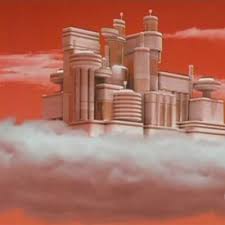 For all its supposed racial liberalism, science fiction television has done a relatively poor job of addressing class issues. Farscape, Star Trek: The Next Generation, Doctor Who, Star Trek: Voyager, and Space 1999 all had nearly zero class analysis in their plots. The original Star Trek series "Cloud Minders,"
pictured to the left, is probably the most direct class analysis ever done by science fiction. It's one of the few science fiction TV episodes to question the nature and purpose of capitalism. While Star Trek ultimately came down on the side of capitalism, the "Cloud Minders" episode clearly implied that the workers were right in making demands for better pay and equipment. Unfortunately, Star Trek's insistence that poverty would disappear in the future ended up serving as a way of erasing working class people from the Star Trek universe. That universe is comfortably middle class, really upper middle class, with no discernible analysis as to how the Federation managed to achieve this poverty-less society. The Marquis, featured in later episodes of DS9 and Voyager at least showed us that Federation colonial policy wasn't all it's cracked up to be.
Babylon 5 did a somewhat better job of dealing with class. Security Chief Garibaldi clearly was a grunt, a guy who had seen better days. And two episodes, "A View from the Gallery" and "By Any Means Necessary" dealt with working class laborers and the issues they dealt with, including oppressive corporate bosses. Earth 2 was also fairly nuanced in its view of labor strife, not picturing a perfect future, but one in which class strife was epidemic. Battlestar Galactica (the reboot) pictured future humans using slave labor forces, as did Blake's Seven, so neither series could be accused of painting a bright picture of the industrialist class. Unfortunately, today, class is too often relegated to the background, in favor of simplistic analyses of race issues that usually end up condemning racial and ethnic minorities more than helping them. Science fiction television still needs a Marxist classic to match the fifty capitalist classics it has given us.
Subscribe to:
Posts (Atom)