Showing posts with label Star Trek. Show all posts

Sunday, August 29, 2010

Aliens I: The Greatest TV Aliens Ever


For me, television science fiction has always been handicapped by its lack of inspiration in designing alien species. Part of this comes simply from budgeterary constraints. Its a lot easier to show knobbly headed humanoid aliens then anything truly unique. The Scarrans (pictured here) are among TV's best efforts at creating a truly unique looking alien. I think Babylon 5, Farscape, and Doctor Who (in both incarnations) have done the best at creating strange species, both from a psychological and biological perspective. Babylon 5 had the most detailed alien cultures of any show, particularly the Minbarri and Narn (admittedly humanoids). It also presented the wonderful Shadows, the first non-bipedal species to play a major role in a science fiction story arc. Farscape usually featured bipedal aliens, but wonderfully strange ones, like the Scarrans, Luxans, Hynerians, Pilots, etc. The cultures may not have exactly been detailed, but there was a wonderful sense of adventurousness in the design of these species. Star Trek has not been as successful, though there have been some wonderful species shown even in that series: the Horta and the Borg being both alien and well thought out. Doctor Who, however, is unique in its ability to create aliens that consistently defied the bipedal humanoid prejudice, even if they looked incredibly corny. The Daleks, for instance, though descended from a humanoid species, are one of the most startingly original creations in all of science fiction television.
Now what I would really like to see is Larry Niven's and Jerry Pournelle's Moties on sci-fi TV. That would be something to see.

Wednesday, July 28, 2010

Postcolonialism and Science Fiction: Star Trek, TOS

Well, I thought I'd begin a series on postcolonial thought and sci-fi, tracing the development of colonial themes in science fiction. Let's start with the original Star Trek. On the plus side, obviously, there is the Prime Directive, which voices a Western fear of interfering with less technologically developed cultures. There are, of course, some paternalistic aspects to the Prime Directive: It assumes, for instance, that technologically inferior cultures will also be less socially developed. But the Prime Directive also serves as a meaningful expression of distrust against the then dominant "Westerns" colonial narratives of shows like Bonanza and Gunsmoke. The practice of arming natives is condemned in "A Private LIttle War" , a particularly elegant attack on U.S. colonial policies in Vietnam. Less welcome critiques of colonialism come in "THe Apple" and "The Return of the Archons", in which Kirk seems to be an arbitrary decider of entire cultures's fates. Star Trek always had to balance the needs of weekly television with its desires to be politically correct, and in the case of postcolonial narratives, the series suffered by the demands of weekly television. However, compared to the traditional non-sci fi narratives of the 1960's, Star Trek: TOS was a quantum leap forward in sophisticating postcolonial arguments. It should therefore be celebrated, but with caution, for some of its episodes (see the Paradise Syndrome) betray an uneasy racism along with their appeal to techno anti-colonialism.

Thursday, July 22, 2010

Klingon Bible

I thought you all might want to know about my next story, which since there's no hope of publishing it, will not violate any copyright restrictions. It's based on the esoteric adventures of a KLV Bible salesman, who goes to a sci-fi conference, ostensibly to save souls, but in reality to indulge in some of the "darker" aspects of Trek (talked about in a previous post). I'm hoping to make this as outrageous as it sounds.
What do you think of efforts to translate the Bible, Shakespeare, etc. into Klingon? Is it a tremendous waste of time, a sign of Western decadence, a harmless diversion? Personally, I'm not sure. I do, however, find Trekkies obsession with their favorite series more than a little unnerving, especially when considering how inferior Trek is to Doctor Who, Blake's 7, Farscape, Babylon 5, Firefly, and the BSG reboot. Come on guys! The time of Trek is gone. Let's get some new ideas already!

Tuesday, July 20, 2010

Sci-Fi Sex Fetishes and Rape


A couple of years ago, there was a great deal of controversy because of claims made by Toronto police that Star Trek was linked to pedophilia and sex fetishes, and that it served as an unhealthy outlet for male rape fantasies. According to Dr. Peter Mezan, a psychoanalyst in New York City, "There is an impulse that is common to perversion and to utopian thinking. The wish is to create a world in which differences make no difference. The great utopian thinkers have been immensely inspiring, but there is a reason that utopian communities have never worked out. In the name of equality of every sort and in the attempt to eliminate the tensions that normally divide us, they propose to create a marvelously unnatural world without the usual boundaries. But then it gets all fucked up."
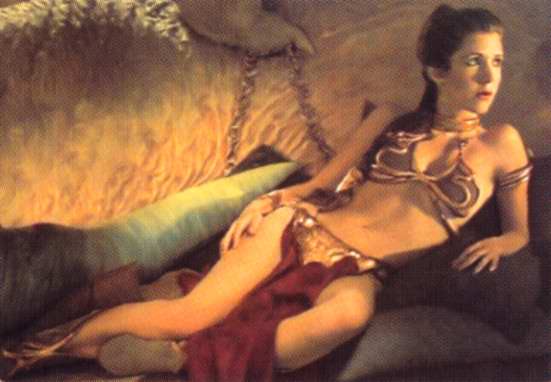
I have included links to these images of women in sci-fi tv, to point out the likelihood of their being some truth to the Toronto police's assertions. Science fiction television and films have been at the forefront of objectifying women, treating them as mere sex objects, rather than as fully developed human beings with minds all of their own. Science fiction television officially condemns rape (see the episode "Violations" of TNG), but itself dresses women in outfits that urge men to merely view thse women as sexual playthings. This does not mean, of course, that women can't or shouldn't wear revealing clothing. I have no problem with that. What I do have a problem with is women having to do so as a prerequisite of their job, for no artistic point. Again, situations vary. The sexuality in "The Devils" for instance, is about as strong as any seen in Western film, but the movie serves as a quite clear condemnation of the enforced chastity of nuns during 17th century France. I would argue that it is therefore justified. Princess Lea sporting a slave girl outfit, by contrast, clearly was meant only to entice male viewers with dreams of chaining a woman by the neck. It is S & M for the kiddie set, and I'm not sure I'm really comfortable with that.
It is entirely possible to make women sexually appealing and yet not exploit them at the same time. One of the finest examples of this process occurred in the original V, in which Faye Grant played Julie Parrish, a sexy resistance leader who nevertheless was not their for eye candy, but served as an example of an intelligent, charming, and important part of the cast. Delenn in Babylon 5, or Starbuck in the reboot of the new BSG also don't always take their clothes off, and yet still remain fundamentally attractive women.
Is science fiction linked to rape? It's hard to say. But clearly, trating women as pinup posters for alien sex fantasies may not be the ideal way of promoting a healthy view of the female body. If science fiction is to sincerely protest rape, it must also protest the pornographization of the female body that creates the sexist attitudes that cause rape. Otherwise, science fiction is merely reinforcing societal prejudices, not liberating us from them.


Sunday, July 11, 2010

Star Trek Next Generation and Mental Illness

I think I've posted on this before, but you should really check out STNG's treatment of mental illness. Particularly the episode "Frame of Mind". STNG manages to be sensitive to abuses in mental health care without joining the fanatic anti-psychiatric bandwagon of certain psychologists and science fiction writers (including the one we dare not speak his name . . . I think you know who I'm talking about). My computer here does not let me copy and paste dialogue, so I can't highlight the excellent aspects of this episode. I think it's significant that STNG is the first series to have a professional counselor on board its ship, and one of the only series to deal realistically with mental illness, through the character of Reginald Barclay. British series have also dealt with mental illness, particularly Blake's 7 and The Prisoner, but have tended to take a somewhat anti-psychiatric bent, not because they are against the mentally ill, but because they were made in an era where psychiatric abuse was more widespread. STNG also dealt with the possibility of new mental illnesses, namely holoaddiction, that is addiction to the virtual reality of the holodeck. I think tomorrow I will deal with that particularly fascinating, though underexplored part, of STNG.

Saturday, July 10, 2010

Sci-Fi Political Thematic Encylopedia

I have been working slowly over the last few months on a sci-fi television political thematic encyclopedia, covering how a variety of television programs deal with issues of race, class, sexuality, gender, fascism, terrorism, religion, conservatism, homophobia, libertarianism, abortion, illegal immigration, Marxism, genetic engineering, cloning, artificial intelligence, and about 30 other topics. It is a massive undertaking. For right now, I am concentrating solely on space operas, and I obviously cannot cover everyone, since the financial costs of purchasing all those sets would be restrictive, and I wouldn't have the time to watch every series.

Here is the list of series I feel are significant enough to definitely be covered with a short explanation of my reasons why:

Alien Nation, Caprica, Firefly, Farscape, Star Trek, TNG, DS9, Voyager, Enterprise, Babylon 5, BSG (original), BSG (reboot), Blake's Seven, Doctor Who (original), Doctor Who (reboot), Earth 2, Crusade, Space Above and Beyond, Space 1999, Andromeda, Torchwood, V (original . . . in later editions I may cover the reboot, but I'm trying to limit shows post 2007. Note that with V I am only using the two original miniseries. I don't consider the actual first original series, back in 1985, as canonical, as the original producer was no longer at the helm and the show clearly suffered from this. Similarly I don't blame Glen Larson for Galactica 1980, even though he was at the helm, and so I don't include that either).

Major Canon Space Operas I don't cover: Earth Final Conflict, Lost in Space, Red Dwarf, Lexx, Stargate SG-1, Stargate Atlantis, Stargate Universe, Tomorrow People, UFO.

My reasoning: The Star Trek series are self-explanatory. Whether you like them or not, Star Trek has put a defining stamp on American sci-fi, so I cover each Trek series, even the otherwise marginal Enterprise. For a similar reason, I cover Doctor Who and its reboots, since they are foundational to British sci-fi, like them or not. Firefly, though short, was good. So was Space Above and Beyond and to a lesser extent, Earth 2. They aren't major shows, but they are politically unusual enough to warrant inclusion. Babylon 5 defines post 1993 sci-fi, so its inclusion, along with Crusade, are obvious. Babylon 5, BSG, Firefly, and Farscape all relied heavily on Blake's Seven, which is why I included that series. Of the series I list here, Space 1999 is probably the most marginal. However, it was the first attempt to create a major post-Star Trek series. The original BSG is also relatively marginal, a one series show with some serious writing flaws. I include it, in part to be a BSG completist, and also because the original BSG marked a critical point in American sci-fi. Alien Nation and V, though not the equal of nineties series, were important enough within the rather sparse 1980's, to merit consideration.

Buck Rogers was obviously fluff, and while I may get to it if I have time, it's not high on my list. Earth Final Conflict was very interesting at points, but suffered from hampered writing. I would include it, if I could obtain all the DVD sets, but there's copyright issues. Several relatively good British programs I decided not to include: The Tommorow People, UFO, Red Dwarf, and Hitchhiker's Guide to the Galaxy. Tommorow People, though it ran a long time, wasn't a major genre influence, neither was UFO. I like Red Dwarf and think I would like Hitchhiker, but I decided not to do comedies so I wouldn't have to handle crap like Mork and Mindy or Futurama. If I get time, I may do Red Dwarf alone, because it is probably the fourth most important British sci-fi series (after B7, Dr. Who, and the Prisoner). Probably my most controversial omission is the Stargate series. Frankly, I find the writing in Stargate putridly bad (a statement that is itself not particularly well written, but I'm going on no sleep here). In addition, the number of seasons of these series would make covering a marginal series like SG-1 unfeasible for the present, especially if I want to cover any major non space-operas.

Non-Space Operas

Ones I hope to cover: Dollhouse, Outer Limits, Twilight Zone, X-Files, Prisoner, Dark Angel, Max Headroom.

Ones I won't cover: Jeremiah, Jericho, Cold Lazarus, Outer Limits (new), Logan's Run, 1990, Planet of the Apes, Quantum Leap, Sliders, Seaquest, Survivors, 4400, Heroes.

My reasoning: Dollhouse has a genuine science-fiction idea and sounds intelligently written (I haven't watched it yet). The original Outer Limits and the original Twilight Zone were, in my opinion, top 25 shows, so they definitely warrant inclusion if I get the time (though occassionally Twilight Zone is more fantasy than sci-fi. X-Files was, after Babylon 5, the most important science fiction show of its decade, and certainly the definitve Earth-bound post Prisoner series. The Prisoner is often ranked as the greatest sci-fi show ever, and I think there is definitely reason to support that viewpoint. Max Headroom was the first attempt at using cyberpunk in sci-fi tv. Obviously it should be included. Dark Angel is more borderline, but there's enough interesting elements that I think it would make for some interesting analysis.

As for the series I reject, Jeremiah was good, but just not genre significant enough. Jericho and Survivors I reject because I don't really want to deal with post-apocalyptic sci-fi, a form of sci-fi I find slightly too respectable and mainstream (though I do regret giving up on both these series, which sound excellent). I would love to do Cold Lazarus, but there's hangups with its DVD release. Logan's Run and Planet of the Apes were not well enough written to warrant a look, nor was Seaquest. 1990 is not available on DVD. I wish it was, as it represents, along with The Prisoner, the only right-leaning sci-fi series, and therefore would make for some interesting discussion. Quantum Leap, for me, is really a fantasy series, not sci-fi. Seaquest, despite the special effects, was marginal. 4400 and Sliders while good, simply weren't significant enough for me to personally take the time to watch them. Leaving Sliders out is really the only difficult choice.

Series that are good but that I don't consider sci-fi: Flash Forward, Lost, Buffy, True Blood, etc. A lot of these series are good, but the sci-fi elements are so minimal that I don't think I can justly merit buying them or taking the time to watch them.

So, you're probably wondering which of these series I own: Of the non-space operas, only Outer Limits and the Prisoner. Dollhouse isn't too expensive, and the X-Files has complete transcripts online, so I don't have to watch the show. Max Headroom is also cheap, and coming out soon, and Dark Angel is reasonably priced. That means only Twilight Zone will bite deep into my pocket, if I decide to cover these series.

Of the space operas: I own Firefly, Farscape, Babylon 5, BSG (old), BSG (reboot), Blake's Seven, Buck Rogers, about 40 old Doctor Whos and 1 season of the new Doctor Who, Earth 2, Red Dwarf, Space ABove and Beyond, Space 1999, UFO, V, and a season of Torchwood. All the Star Trek series I can find exact transcripts online, which is good, as their price is way out of my range. Crusade is relatively cheap, which means my main expenditures will be on buying Doctor Who and Torchwood seasons and episodes. I may not include every Who episode, particularly some politically marginal ones like The Romans, Space Musuem, and the Chase.

So wish me luck on this political extravaganza, that will probably take me 10 years to research and another 10 years to complete

Friday, July 9, 2010

Babylon 5 on religion

Babylon 5 was one of the most interesting series in its treatment of religion. Brother Theo promoted a relatively promising view of Catholicism that acknowledged its ambiguity. G'kar became an exalted spiritual leader. I found the Minbarri's complex notions of religion to be one of the first realistic portrayals of how an advanced alien culture might view religious experience (G'kar himself eventually comes to this view). The episode "Parliament of Dreams" realistically portrays a multicultural religious movement. About the only thing missing from Babylon 5 is a realistic treatment of evangelical religion and Islam. I would argue that historically these two religious movements have faired rather badly at the hands of sci-fi television writers. Fundamentalism in particular, was a target for derision by the writers of STNG and DS9 (anyone remember when Vedek Winn goes "creationist wacko" on Keiko Obrien). Islam, meanwhile, has never been adequately shown in any sci-fi series. Indeed, in sci-fi television, the assumption seems to be that only Christianity (Catholicism and an occasional liberal Protestant) and Judaism exist. Examples of detailed analyses of other religions are rather scare. The Doctor Who episode "Kinda" explores some Buddhist themes, and Star Trek Voyager condescendingly dealt with Native American religion, but overall most sci-fi characters are Christian, secular, New Age, or (on rare occassion) Jewish in outlook. Surely there's enough complexity in the world to now deal with religions other than the traditional ones America has gifted us with. And I also think we need more nuanced treatments of sci-fi fundamentalism, not Stargate SG-1 and DS9, but the reboot of Battlestar Galactica and the excellent Dune miniseries

Wednesday, January 13, 2010

Class in Science Fiction Television

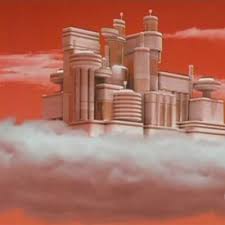
For all its supposed racial liberalism, science fiction television has done a relatively poor job of addressing class issues. Farscape, Star Trek: The Next Generation, Doctor Who, Star Trek: Voyager, and Space 1999 all had nearly zero class analysis in their plots. The original Star Trek series "Cloud Minders,"
pictured to the left, is probably the most direct class analysis ever done by science fiction. It's one of the few science fiction TV episodes to question the nature and purpose of capitalism. While Star Trek ultimately came down on the side of capitalism, the "Cloud Minders" episode clearly implied that the workers were right in making demands for better pay and equipment. Unfortunately, Star Trek's insistence that poverty would disappear in the future ended up serving as a way of erasing working class people from the Star Trek universe. That universe is comfortably middle class, really upper middle class, with no discernible analysis as to how the Federation managed to achieve this poverty-less society. The Marquis, featured in later episodes of DS9 and Voyager at least showed us that Federation colonial policy wasn't all it's cracked up to be.

Babylon 5 did a somewhat better job of dealing with class. Security Chief Garibaldi clearly was a grunt, a guy who had seen better days. And two episodes, "A View from the Gallery" and "By Any Means Necessary" dealt with working class laborers and the issues they dealt with, including oppressive corporate bosses. Earth 2 was also fairly nuanced in its view of labor strife, not picturing a perfect future, but one in which class strife was epidemic. Battlestar Galactica (the reboot) pictured future humans using slave labor forces, as did Blake's Seven, so neither series could be accused of painting a bright picture of the industrialist class. Unfortunately, today, class is too often relegated to the background, in favor of simplistic analyses of race issues that usually end up condemning racial and ethnic minorities more than helping them. Science fiction television still needs a Marxist classic to match the fifty capitalist classics it has given us.