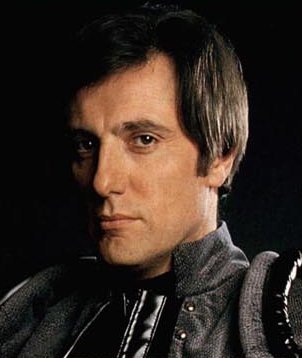
So, I decided to make a list of my best sci-fi Hitler stand ins. Scorpius is on that list of course. He is suitably evil and though not concerned with genetic purity, he does have that certain sense of menace that all great villains have. From Doctor Who, I would nominate Davros, particularly in the episode Genesis of the Daleks. Davros is intensely committed to genetic purity, and has that desire for self-perpetuation that is at the heart of all genetic dictatorships. Servalen, from Blake's 7, has that Nazi-like demeanor and uncaring nature for other life, characteristic of all the best of the worst dictatotrs. Star Trek never really gave us a sufficiently menacing dictator, but Khan Noonian Singh wasn't bad. Finally, Babylon 5 gave us the eponymous President Clark and his henchmen among the Shadows. Which sci-fi dictator would you rank first (from this list or any other). Personally, my vote would go for Scorpius or Davros. Who do you think is science fiction's ultimate baddie?
Sunday, July 18, 2010
Saturday, July 17, 2010
Conservatism in Science Fiction Television
Labels:
B5,
Babylon 5,
conservatism,
Ferengi,
Tea Party,
The Prisoner
Space Hookers: Prostitution and Pornography in the Final Fronteir
Friday, July 16, 2010
The Political Wisdom of Kerr Avon
Avon: [about the Rebellion's new figurehead] He is strongly identified with rebels, you see, and very popular with rabbles. They will follow him, and he will fight to the last drop of *their* blood. Idealism is a wonderful thing. All you really need is someone rational to put it to proper use
Kerr Avon: Show me someone who believes in anything and I will show you a fool
Kerr Avon: I have never understood why it should be necessary to become irrational in order to prove that you care, or, indeed, why it should be necessary to prove it at all.
Kerr Avon is the ultimate in nihilistic pessimism. Unlike the loving Mr. Spock, who is never far from hugging Kirk and company, Avon is prone to kill the one's he loves. He kills his best friend, one of the heroes of the series, kills his lover, is willing to be a drugpusher to further the terrorist cause, and nearly kills another friend in order to save himself from crash-landing on a planet. And he's the hero - the villains are worse. Blake's 7 is the only science fiction series I've seen that really takes its pessimistic statements about human nature seriously. Avon does not believe in idealism, and takes his relativistic ethics to their logical conclusions, routinely threatening to kill his friends, his enemies, and even small cuddly aliens. Avon doesn't believe in idealism and the producers of Blake's 7, particularly in the last season continually reinforced the series's notion that rebellion against authority is ultimately futile, because the government is all powerful. This is a depressing message, and Kerr Avon a tragic messenger, but Blake's 7 is unique in how honest it is with its viewers. It tells us "We're fools. We are the mess. We are what's wrong with the world." And for that, this series deserves to be remembered as some of the best science fiction ever to grace the small screen.
Weapons Fire rate, Accuracy in Sci-Fi
Science fiction television shows are famous for laser pistols, plasma guns, etc., so I thought it would be fun to examine how these shows apply weapons technology, particularly fire rates, and what it says about these series.
When it comes to space combat, clearly the reboot BSG and Babylon 5 did the best job. These two series tried to make such combat work within the relative constraints of zero g, and even though they used fighter craft, they did not do the crazy gyrations of X-Wings or the old Colonial Vipers. Babylon 5 combat, in particular, stuck rigidly to this Zero-g application, even when it made the battles a bit slow at times. Star Trek wasn't terribly bad in this regard either. Unrealistic space fights, in any case, seem to be more characteristic of sci-fi movies then television (Transformers, for instance).
Ground weapons, on the other hand, are rarely portrayed realistically. Take Star Trek's phasers or the blasters of the old BSG colonials. These weapons were portrayed as the height of technological advancement, yet their fire rate was so slow that it would have made more sense to just use SMG's and other ballistic weaponry. Indeed, few sci-fi shows have solved this problem. Only Babylon 5 created energy weapons with high enough fire rates to convince the viewer that the weapons are more deadly than those used today. Even the great Farscape series's weapons fired somewhat slowly. That is why I commend the reboot BSG for using ballistic weaponry like that used today. Realistically, I don't think energy weapons, as they stand today, could be used for anything other than tank-killing. BSG simply makes more sense.
I think there is another important reason to keep using the ballistic weaponry. If we have to show weaponry on television, we should show weaponry that has real bloody consequences. BSG does this, but most other sci-fi series have shied away from showing the true human cost of weapons fire. Perhaps if more American sci-fi series showed blown up Cylon children, and not fade aways, we wouldn't be killing real children in Iraq and Afghanistan. Series like Farscape and Star Trek, though good, too often allow people to fantasize about violence without having to deal with the true consequence of that violence. It's time for that to change.
The stupidity of STNG abortion + genetic engineering politics
I finally figured out how to work the copy and paste function, so I was able to paste this quote from Wikipedia on the STNG episode "Up the Long Ladder" and its relationship to abortion and genetic engineering politics.
"Up the Long Ladder" was criticized from two directions. Snodgrass recalled, "I got enormous flack from the right to life coalition because they destroyed the clones. They thought I was condoning abortion. In fact, I did put a line in Riker's mouth that was very pro-choice and the right to life coalition went crazy. He says I told you that you can't clone me and you did it against my will, and I have the right to have control over my own body. That's my feeling and it was soapbox, and it was one I got to get on. I was supported by Maurice all the way." (Captains' Logs: The Unauthorized Complete Trek Voyages)
Now, please don't get me wrong. I'm not condemning pro-choicers here, who have many excellent points (I happen to be on the opposite side of the aisle on this issue, though I lean heavily left on almost all others). I merely want to point out that Snodgrass's particular methodology of promoting pro-choice politics in this episode is quite problematic. First of all, an adult clone is not a fetus, and should not be equated with one. It is a fully rational, fully adult being living totally outside a womb. There is no issue of embryonic parasitism here, which is one of the main justifications for a pro-choice position (and a good justification, at that). Nor do clones fall under the second major argument in favor of a pro-choice position: that fetuses are human, but not persons. This position, advocated by Peter Singer, argues that to be a person, a human being must be capable of feeling pain and interacting cognitively with the world. While the Singerian position can be somewhat problematic (since it can be used to justify infanticide and certain forms of euthanasia), it is logically consistent and even though I'm pro-life\anti-abortion, I do not see it as fundamentally unethical. The problem in this episode, however, is that Riker's clone is fully sentient and fully alive. No one questions this. Riker's justification for killing the clone is that he was "cloned against his will". Again, it's very understandable to argue that a woman shouldn't be forced to carry a child to term if she's a victim of sexual assault, but the situation here is simply not analagous. A clone exists outside of the womb, and forceable cloning, while reprehensible, in this episode creates fully alive adult beings (a tragic scientific inaccuracy). You can abort a fetus before it comes to term, but I don't think any rape victim, pro-choice or pro-life, would argue she has the right to kill her child after she's given birth to it.
STNG's simplistic approach to abortion and cloning\genetics technology has severely hampered the series over the years. In Federation society, genetically engineered people are legally discriminated against, yet the Federation is held up as an ideal. Clones and A.I.'s are always shown as "just short" of fully human, a position which denigrates these lifeforms unjustly. Promoting one's personal political viewpoints on abortion can be productive, but not if it comes at the expense of life that no one disagrees is human.
"Up the Long Ladder" was criticized from two directions. Snodgrass recalled, "I got enormous flack from the right to life coalition because they destroyed the clones. They thought I was condoning abortion. In fact, I did put a line in Riker's mouth that was very pro-choice and the right to life coalition went crazy. He says I told you that you can't clone me and you did it against my will, and I have the right to have control over my own body. That's my feeling and it was soapbox, and it was one I got to get on. I was supported by Maurice all the way." (Captains' Logs: The Unauthorized Complete Trek Voyages)
Now, please don't get me wrong. I'm not condemning pro-choicers here, who have many excellent points (I happen to be on the opposite side of the aisle on this issue, though I lean heavily left on almost all others). I merely want to point out that Snodgrass's particular methodology of promoting pro-choice politics in this episode is quite problematic. First of all, an adult clone is not a fetus, and should not be equated with one. It is a fully rational, fully adult being living totally outside a womb. There is no issue of embryonic parasitism here, which is one of the main justifications for a pro-choice position (and a good justification, at that). Nor do clones fall under the second major argument in favor of a pro-choice position: that fetuses are human, but not persons. This position, advocated by Peter Singer, argues that to be a person, a human being must be capable of feeling pain and interacting cognitively with the world. While the Singerian position can be somewhat problematic (since it can be used to justify infanticide and certain forms of euthanasia), it is logically consistent and even though I'm pro-life\anti-abortion, I do not see it as fundamentally unethical. The problem in this episode, however, is that Riker's clone is fully sentient and fully alive. No one questions this. Riker's justification for killing the clone is that he was "cloned against his will". Again, it's very understandable to argue that a woman shouldn't be forced to carry a child to term if she's a victim of sexual assault, but the situation here is simply not analagous. A clone exists outside of the womb, and forceable cloning, while reprehensible, in this episode creates fully alive adult beings (a tragic scientific inaccuracy). You can abort a fetus before it comes to term, but I don't think any rape victim, pro-choice or pro-life, would argue she has the right to kill her child after she's given birth to it.
STNG's simplistic approach to abortion and cloning\genetics technology has severely hampered the series over the years. In Federation society, genetically engineered people are legally discriminated against, yet the Federation is held up as an ideal. Clones and A.I.'s are always shown as "just short" of fully human, a position which denigrates these lifeforms unjustly. Promoting one's personal political viewpoints on abortion can be productive, but not if it comes at the expense of life that no one disagrees is human.
Thursday, July 15, 2010
Appeasement in Science Fiction
I recently finished another BSG episode, in the Eastern Alliance story arc. As is typical in the old BSG, the tone is anti-appeasement. Anti-appeasement sci-fi themes are fairly common. V condemned appeasement, as did an episode of Babylon 5. Even relatively sophisticated takes on fascism (Genesis of the Daleks, for instance) and warmongering tend to view appeasement as a de facto bad. Obviously, this viewpoint stems from Neville Chamberlain's tragic missteps with Hitler. Yet, I am not sure how wise it is to always portray appeasement as evil. There have been times where acts of appeasement could have alleviated much suffering - for instance, in Saddam's Iraq. Other times, anti-appeasement rhetoric is used against regimes that have been more wronged by the U.S. than we have been by them. For instance, anti-appeasement rhetoric is commonly used against Cuba, which had quite reasonable fears for its safety during the 50's and 60's (U.S. involvement in Cuba is a rather sordid tale of coup-making and imperialism, for those who don't know). The theme of appeasement is interesting in the original BSG, because it contrasts rather sharply with several episodes in the series that promoted pascifistic politics. Apparently, BSG wanted to have its cake and eat it too. But I think the show's rather naive faith in the military (a faith that sometimes the modern BSG seems to share), ultimately limits its success when compared to non-military oriented shows, like Blake's 7, Firefly, and Farscape, which can take far more critical views of government and politics, and still get away with it.
Subscribe to:
Posts (Atom)